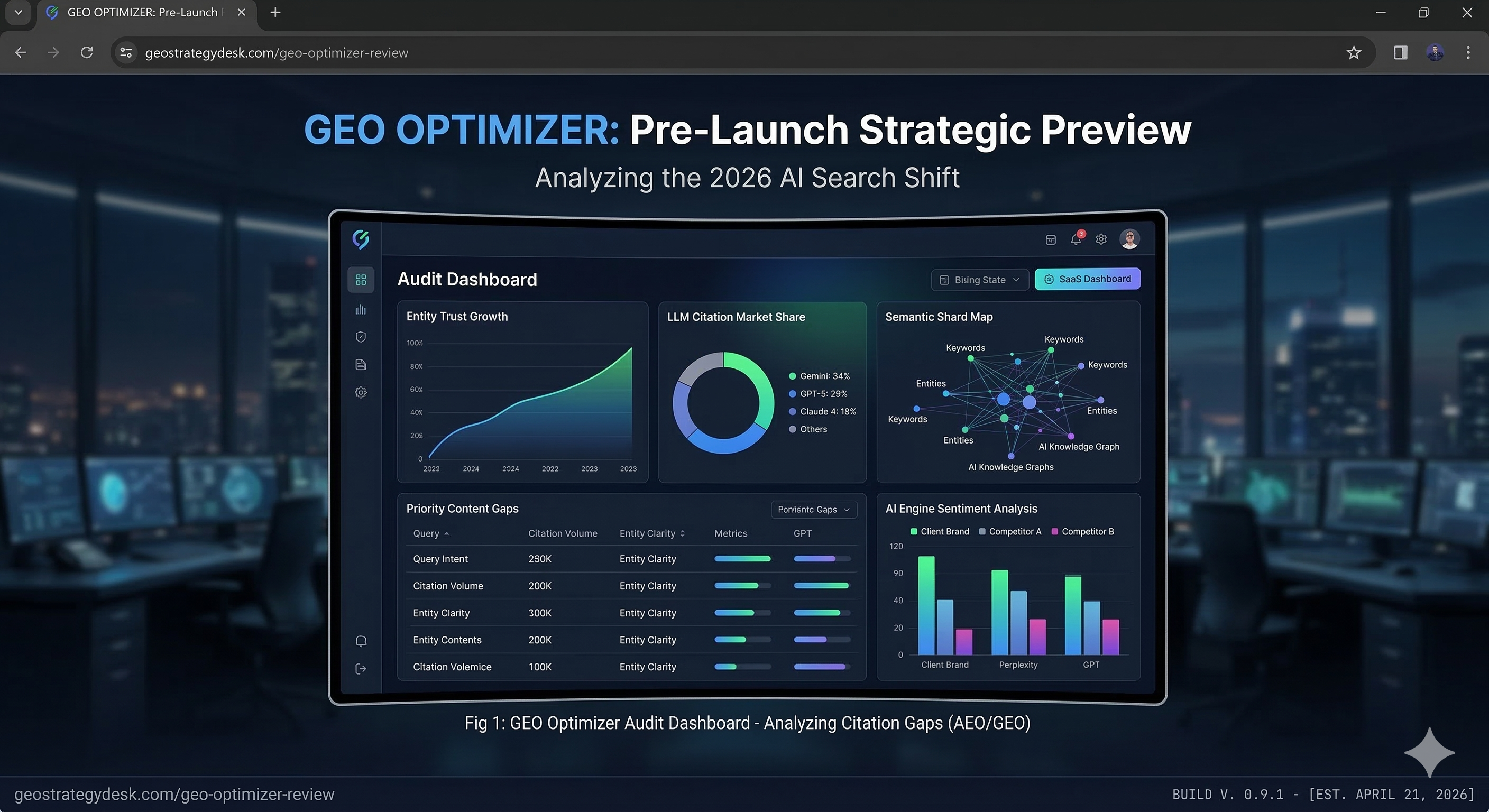
Inside the GEO Optimizer Audit Dashboard
The GEO Optimizer Audit Dashboard provides four real-time intelligence panels: Entity Trust Growth tracking, LLM Citation Market Share across Gemini, GPT-5, and Claude, a Semantic Shard Map visualising entity-keyword relationships, and an AI Engine Sentiment Analysis benchmarking your brand against competitors. These panels surface the citation gaps the universal content blueprint is designed to close.
The AI Search Shift: Why Your Current Playbook Is Obsolete
AI search referrals to retail sites grew 1,300% during the 2024 holiday season, with AI-driven visitors showing a 23% lower bounce rate than traditional search traffic. Despite this, 94% of marketing leaders planning to increase GEO spending in 2026 cite scalable content creation as their primary unsolved challenge — because most available tools measure the problem rather than solve it.
The rapid integration of conversational AI into search is not a future trend. ChatGPT, Google AI Overviews, Perplexity, and Gemini are already the first point of contact for millions of purchase-intent queries. Generative Engine Optimisation — also called AEO, LLMO, and GSO — is the practice of structuring content so that AI answer engines cite, summarise, or recommend it in their responses.
The dominant response from the tool market has been tracking dashboards: platforms that monitor brand mentions inside AI answers and report share-of-voice. These tools are abundant. And according to empirical research, they are solving the wrong problem — measuring outcomes without providing a validated methodology to change them.
Their primary challenge is not budget — it is the scalable creation of effective, AI-optimised content. Most available tools measure the problem. They do not solve it.
The 15 GEO Heuristics That Empirical Research Says Don't Work
Academic research testing the 15 most widely cited GEO best practices found no consistent, predictable improvement in AI search visibility from applying them. Some showed a minor positive effect in one context and a negative effect in another. The research concludes that GEO signals diverge substantially from the classical SEO playbook — and that these popular heuristics are an unreliable foundation for any scalable AI visibility strategy.
These are the tactics that practitioners, agencies, and most GEO tools recommend. All 15 were put to the test in rigorous empirical research. None passed as reliable primary drivers of AI citation:
The Universal Blueprint: What the Research Found Actually Works
A landmark empirical study identified a stable, domain-agnostic four-pillar content blueprint that consistently and significantly outperformed all 15 common GEO heuristics in controlled testing. The blueprint is based on the universal architecture of large language models — not industry-specific subject matter — making it reliably effective across e-commerce, SaaS, healthcare, and local services alike.
Conceptual Scaffolding
Structure the introduction as a "table of concepts" for the AI, not a summary for human readers. Explicitly define key entities, their attributes, and their relationships before elaborating.
Vector-Priming Language
Use specific transitional phrases and logical connectors aligned with how LLMs process information flows — helping the model map your content to its existing knowledge graph more efficiently.
Entity-Property-Value Triples
Embed machine-readable statements of fact: Product [Entity] → Feature [Property] → Specific Value [Value]. AI models parse and trust this format for recommendations and citations.
Disambiguation & Context
Proactively address potential ambiguities. Structure content to provide immediate, definitive context — helping the AI correctly categorise and recall your specific product in relevant answers.
GEO Optimizer vs. Enterprise Platforms
GEO Optimizer operates at the implementation layer: schema, metadata, entity structure, and universal blueprint application. Enterprise platforms including Profound, Semrush AIO, and BrightEdge operate at the intelligence layer: citation monitoring, query fanout analysis, and cross-LLM benchmarking. These are sequential layers in a complete GEO stack — not competing alternatives.
| Capability | GEO Optimizer | Semrush AIO | Profound | BrightEdge |
|---|---|---|---|---|
| Universal Blueprint Execution | ✓ Core feature | ✗ | ✗ | ✗ |
| Schema / Structured Data | ✓ Automated | ◑ Manual | ◑ Manual | ◑ Manual |
| WordPress One-Click Workflow | ✓ Native | ✗ | ✗ | ✗ |
| Citation / Mention Monitoring | ✗ | ✓ Cross-LLM | ✓ Advanced | ✓ Enterprise |
| Query Fanout Analysis | ✗ | ◑ Limited | ✓ Core feature | ◑ Limited |
| Share-of-Answer Reporting | ✗ | ✓ | ✓ Advanced | ✓ |
| Entity / Knowledge Graph | ✗ | ◑ | ◑ | ✓ Core feature |
| Front-End Price | $47 one-time | ~$500+/month | Enterprise | Enterprise |
Pricing & Value Analysis
GEO Optimizer launches on JVZoo on 21 April 2026 at a $47 front-end price — a one-time payment for a WordPress plugin that automates the research-validated universal content blueprint. Enterprise-tier alternatives (Profound, BrightEdge) run to four-figure monthly retainers. Semrush AIO starts at ~$500/month. For teams already paying for a tracking platform, GEO Optimizer is a complementary implementation layer, not a replacement.
Limitations to Know Before You Buy
GEO Optimizer does not include citation monitoring, share-of-answer dashboards, query fanout analysis, or cross-LLM benchmarking — capabilities found in enterprise platforms Profound, Semrush AIO, and BrightEdge. It is a WordPress-native implementation tool; non-WordPress users will need to apply the universal blueprint manually. The affiliate link is not yet live; the product launches 21 April 2026 on JVZoo.
Who Should Use GEO Optimizer?
GEO Optimizer delivers the highest ROI for three buyer profiles: enterprise marketing leaders needing a scalable content governance framework; e-commerce managers needing entity-property-value structure on product pages; and SEO professionals needing a research-validated methodology to replace the 15 heuristics that empirical evidence has shown to be unreliable.
The Enterprise Marketing Leader
Scale AI-optimised content across business units without relying on individual intuition. GEO Optimizer converts the universal blueprint into a teachable, repeatable workflow any content team member can follow.
The E-commerce Manager
AI shopping agents recommend products based on unambiguous entity-property-value data. GEO Optimizer structures your product pages in the exact format LLMs need to drive recommendations and conversions.
The SEO Professional
Your credibility depends on delivering repeatable results. GEO Optimizer gives you a validated methodology — elevating you from tactician to strategic architect of AI search visibility.
Frequently Asked Questions
The most searched questions about GEO Optimizer centre on how the strategy works, whether traditional SEO still matters, and whether common best practices are reliable. Short answers: GEO works through entity structure not keywords; SEO remains essential but must be complemented by GEO; the 15 most popular GEO tactics are empirically unreliable without the universal blueprint underneath them.